Fractional rings of tangent spheres
Soddy’s hexlet consists of a ring of six spheres, tangent to each other consecutively around the ring, and another ring of three consecutively-tangent spheres, so that all the spheres in the first ring are tangent to all the spheres in the second ring. If you keep one ring fixed, you can rotate the other ring continuously, possibly changing the sizes of some of the spheres as they rotate but keeping the pattern of tangencies unchanged. Here’s a nice animation I found on Wikipedia, where the ring of six spheres rotates continuously while the other ring of three spheres (the central blue one and the two green planes, considered as degenerate spheres tangent at infinity) stays fixed. The larger red sphere is not part of this configuration and I don’t know why the author of this animation included it.
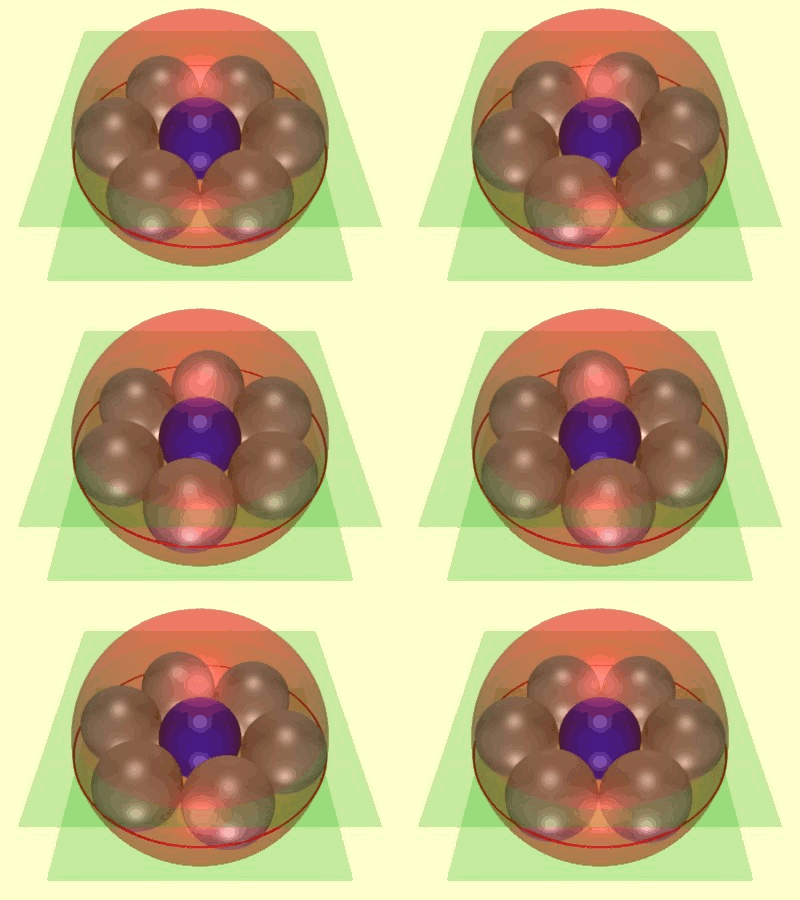
We can describe the graph of tangencies of these nine spheres by using the join operation on graphs, which combines two graphs by adding edges from all vertices of one graph to all vertices of the other. With a cycle of \(k\) vertices denoted as \(C_k\) and the join denoted as \(+\), the graph of Soddy’s hexlet is \(C_3+C_6\).
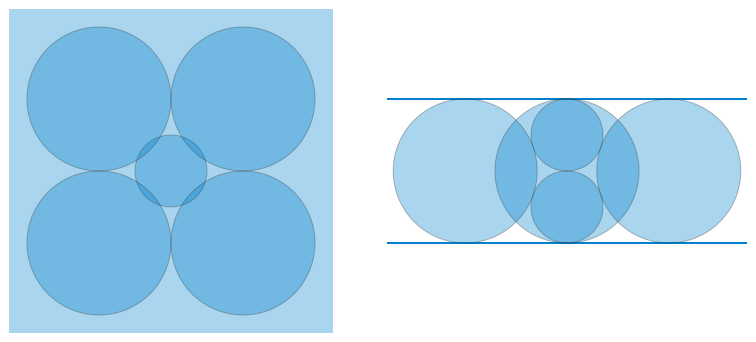
A few years ago I wrote here about an analogous system of spheres in two rings, with four spheres in each ring. (I vaguely recall seeing some mention of this in a paper from the 1950s by Coxeter but now I can’t find it again; it’s closely related to his 1954 “Arrangements of equal spheres in non-Euclidean spaces”.) Below again are two perpendicular views of a symmetric realization with one ring consisting of four congruent spheres, and the other ring consisting of two planes (degenerate spheres) and two more spheres of half the radius of the first ring. The two planes are tangent at infinity. As a join the graph of tangencies of these eight spheres is \(C_4+C_4\) but you might be more familiar with the same graph as \(K_{2,2,2,2}\).
But these two examples are not the only systems of tangent spheres whose tangencies form a join of cycles! If we allow non-consecutive spheres within a single ring to cross through each other rather than requiring them to stay separated, we can also realize the graphs \(C_5+C_{10}\), \(C_7+C_{14}\), \(C_8+C_8\), \(C_9+C_{18}\), \(C_{11}+C_{22}\), \(C_{12}+C_{12}\), etc.
The realizations depicted above, where one of the two rings consists of congruent spheres with their centers at the vertices of a regular polygon, may seem symmetric enough, but to describe these additional joins of cycles as tangent spheres it is helpful to reach an even more symmetric point of view (but one that is unfortunately difficult to visualize because it involves a fourth dimension): use stereographic projection to lift the Euclidean space \(\mathbb{R}^3\) in which these tangent spheres live, to the unit \(3\)-dimensional hypersphere
\[\mathbb{S}^3=\{(x,y,z,w)\mid x^2+y^z+z^2+w^2=1\}\subset\mathbb{R}^4.\]This lifting process takes spheres to spheres, preserves their tangencies, and is reversible, so that any system of tangencies that can be realized in \(\mathbb{R}^3\) can be realized in \(\mathbb{S}^3\) and vice versa. In \(\mathbb{S}^3\), Soddy’s hexlet has a particularly nice realization in which the ring of six spheres has its centers on a regular hexagon in the plane \(z=w=0\), with radii \(\tfrac{\pi}{6}\) (measuring these radii as great-circle distances on \(\mathbb{S}^3\), or equivalently angles as viewed from the origin). This radius is chosen so that the sum of the diameters of the spheres is exactly \(2\pi\), the length of the equator of \(\mathbb{S}^3\) in this plane. Correspondingly, the ring of three spheres has its centers on an equilateral triangle in the perpendicular plane \(x=y=0\), with radii \(\tfrac{\pi}{3}\). Again their diameters sum to \(2\pi\). Because the six-sphere ring and the three-sphere ring lie in perpendicular planes, the centers of the spheres from different rings are all at angular distance exactly \(\tfrac{\pi}{2}\) from each other. Because their radii \(\tfrac{\pi}{6}\) and \(\tfrac{\pi}{3}\) sum to the distance \(\tfrac{\pi}{2}\) between their centers, the spheres are tangent. Rotating \(\mathbb{S}^3\) around one of these two perpendicular planes and then projecting into \(\mathbb{R}^3\) induces the rotation of the rings of spheres within \(\mathbb{R}^3\) that we have already seen.
But now instead of a hexagon of sphere centers on \(\mathbb{S}^3\) with radius \(\tfrac{\pi}{6}\) in one plane, and a triangle of sphere centers with radius \(\tfrac{\pi}{3}\) in a perpendicular plane, we can consider four integer parameters \(a\), \(b\), \(c\), and \(d\), a \(b\)-gon of sphere centers with radius \(\tfrac{a\pi}{b}\) in one plane, and a \(d\)-gon of sphere centers with radius \(\tfrac{c\pi}{d}\) in the other perpendicular plane. As long as \(a\) is coprime to \(b\), the \(b\)-gon of spheres will have tangencies that form a ring of spheres, wrapping around the \(z=w=0\) equator \(a\) times. And correspondingly, as long as \(c\) is coprime to \(d\), the \(b\)-gon of spheres will have tangencies that form a ring of spheres, wrapping around the \(x=y=0\) equator \(a\) times. (If they are not coprime, then we instead get multiple separate rings, and if we try non-integer parameters then the rings of spheres will not be tangent or will not close up after finitely many steps.) And finally, the spheres from the first ring will be tangent to the spheres in the second ring whenever \(\tfrac{a\pi}{b}+\tfrac{c\pi}{d}=\tfrac{\pi}{2}\), which is to say whenever \(\tfrac{a}{b}+\tfrac{c}{d}=\tfrac{1}{2}\).
So what are the solutions of \(\tfrac{a}{b}+\tfrac{c}{d}=\tfrac{1}{2}\)? To sum to \(\tfrac{1}{2}\), the least common denominator of the two fractions on the left hand side must be even, \(2k\) for some \(k\). The two numerators for the common denominator must sum to \(k\). If \(k\) is odd, one of the numerators is even and one is odd, and we get a solution of the form \(\tfrac{j}{k}+\tfrac{k-2j}{2k}=\frac{1}{2}\). If \(k\) is even, both of the numerators must be odd (else \(2k\) would not be the least common denominator) and we get a solution of the form \(\tfrac{j}{2k}+\tfrac{k-j}{2k}=\frac{1}{2}\). And of course both numerators must be positive. Plugging in \(k=2,3,4,5,\dots\) gives \(\tfrac{1}{4}+\tfrac{1}{4}=\frac{1}{2}\) (the quadlet of my previous post), \(\tfrac{1}{3}+\tfrac{1}{6}=\frac{1}{2}\) (the hexlet), \(\tfrac{1}{8}+\tfrac{3}{8}=\frac{1}{2}\) (two rings of eight spheres, one overlapping and wrapping three times around), \(\tfrac{1}{5}+\tfrac{3}{10}=\frac{1}{2}\), \(\tfrac{2}{5}+\tfrac{1}{10}=\frac{1}{2}\) (two different ways of realizing \(C_5+C_{10}\)), etc. Each of these fractional equations gives us two tangent rings of overlapping spheres on \(\mathbb{S}^3\) and, by stereographic projection, in \(\mathbb{R}^3\).