Ceramic orthogonal polyhedra
David Richter, a mathematician at Western Michigan University, recently found himself with a surfeit of ceramic orthogonal polyhedra and, knowing of my own interest in orthogonal polyhedra, generously offloaded two of them to me. They fit nicely in my office together with the paper and crochet orthogonal polyhedra I already had:
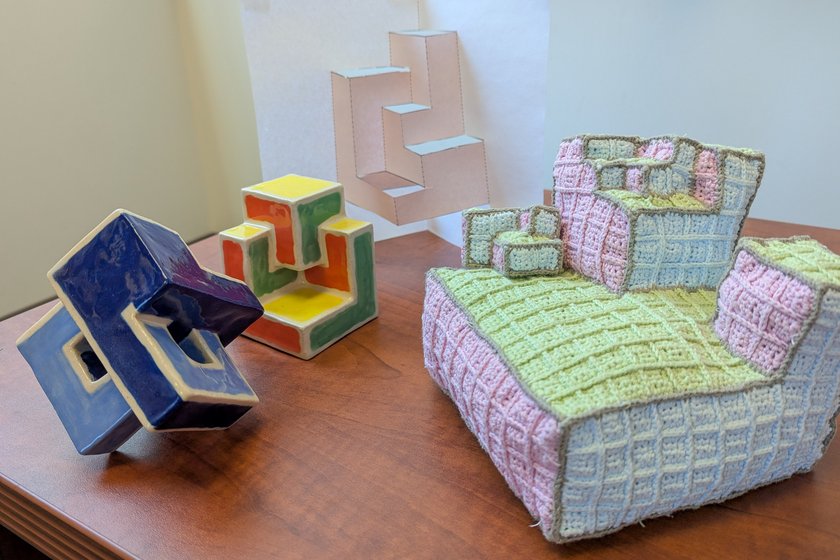
The blue one is an orthogonal realization of Boy’s surface, an immersion of the projective plane into three-dimensional space with three-way symmetry and a single triple crossing point. The idea to make an orthogonal version comes from Jean Pierre Petit’s Le Topologicon, where its relation to the usual curved version can maybe be seen more clearly than in my photographs.

The model hides a hidden graph embedding: the uncolored edges form the boundaries of a hemi-dodecahedron, an embedding of the Petersen graph with six pentagonal faces, each adjacent to all five others.
 |
 |
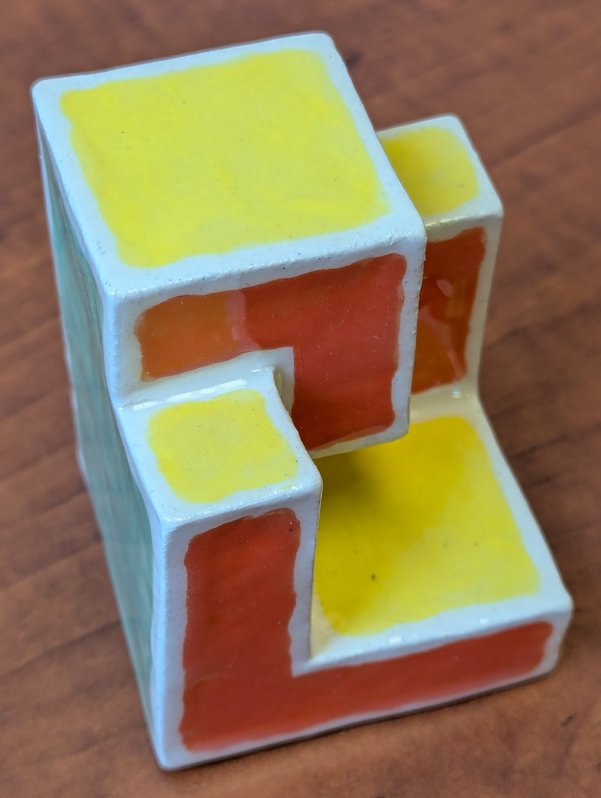
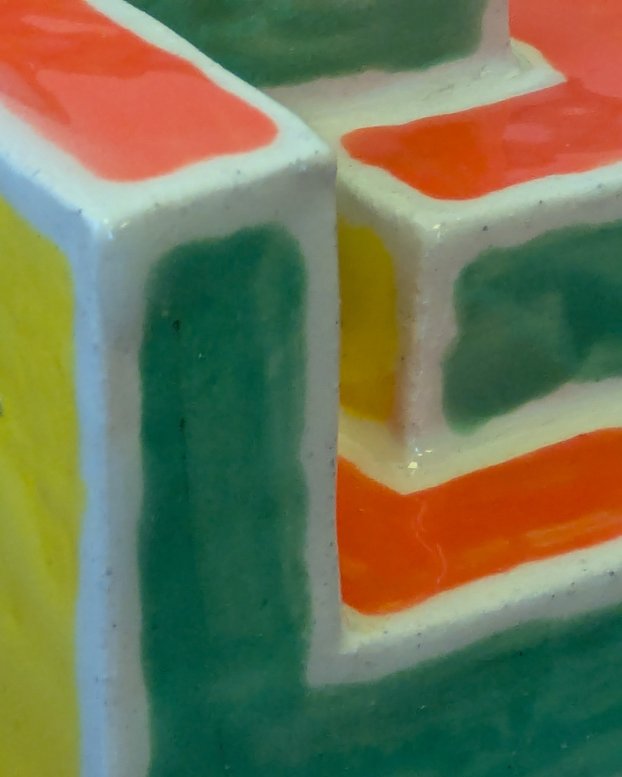
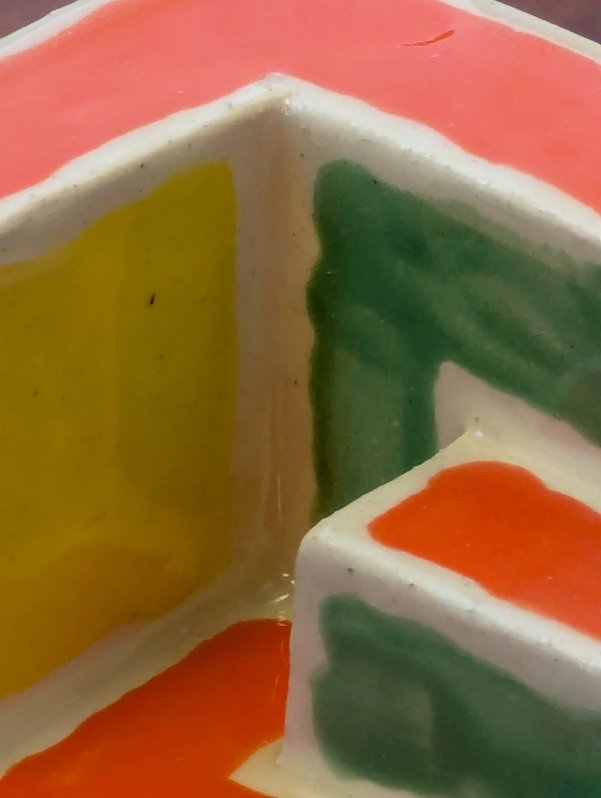
The other ceramic model, colored yellow, green, and red, is an orthogonal realization of the permutohedron or, almost the same thing, the Cayley graph of the four-element symmetric group generated by the three swaps of consecutive elements. Abstractly, it’s the same embedded graph as the paper kirigami model behind it in the family portrait, which I constructed and wrote about in 2009, but what this one loses in orthogonal nonconvexity it makes up for in bilateral symmetry.
 |
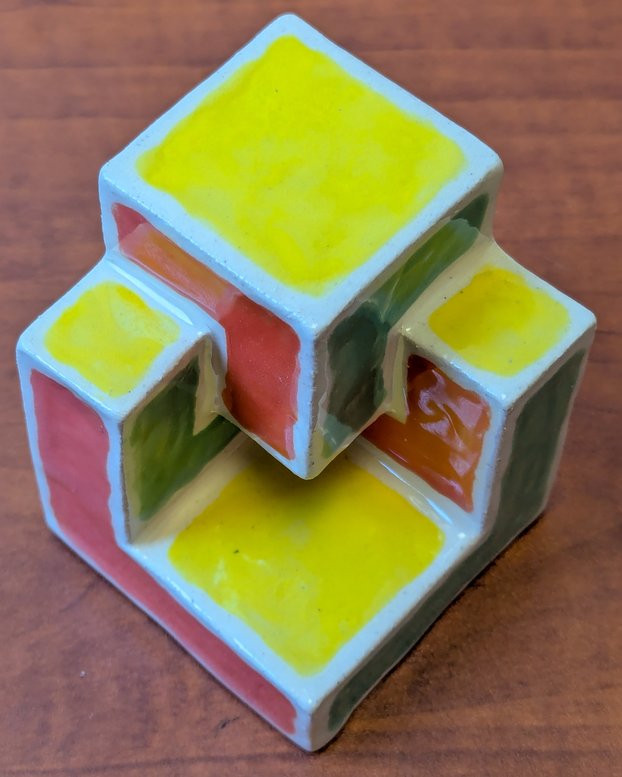 |
Here are a few more views of it:
 |
 |
 |
When viewed top-down their shapes almost look like writing to me. You can see a signature and date in the hollow of the Boy’s surface.

Richter also has a couple of papers on orthogonal polyhedra: “Generic Orthotopes” (arXiv:2210.12012) and “Ehrhart Polynomials of Generic Orthotopes” (arXiv:2309.09026).