Linkage
-
Morphing between a polyhedron and its dual using 3d-printed scissor-link edges (\(\mathbb{M}\)) raises the question of which polyhedra can be realized in this way. The linked paper by Liao, Kiper, and Krishnan suggests that they need to be midscribed and have equal-length edges to avoid binding during the morph. A much weaker but obvious necessary condition is that for each pair of dual edges the lengths are equal. But it is unclear which polyhedra have realizations with this property.
-
Frank Vigor Morley’s realizations of regular polygons using knotted paper strips (\(\mathbb{M}\)). Morley was the son of Frank Morley, a geometer known for Morley’s theorem on triangle trisectors.
-
The Brouwer fixed-point theorem in action, as exhibited by Github labels (\(\mathbb{M}\), via): If you try to define a continuous function from text colors to contrasting background colors, there will be some text colors whose background is the same as the text rather than contrasting with it. Discontinuity is necessary to avoid this. This is from 2023 so I suspect the specific buggy behavior is long fixed but the phenomenon will recur for any attempt like this one to define a formula using only continuous building blocks.
-
Complexity in Computer Science (\(\mathbb{M}\)), free online textbook, about to be published through Cambridge University Press.
-
Archive.today / archive.is / archive.ph etc initiates a DDOS attack against a blogger they accused of doxing them, sparking calls to blacklist them from reference link archiving on Wikipedia (\(\mathbb{M}\)).
-
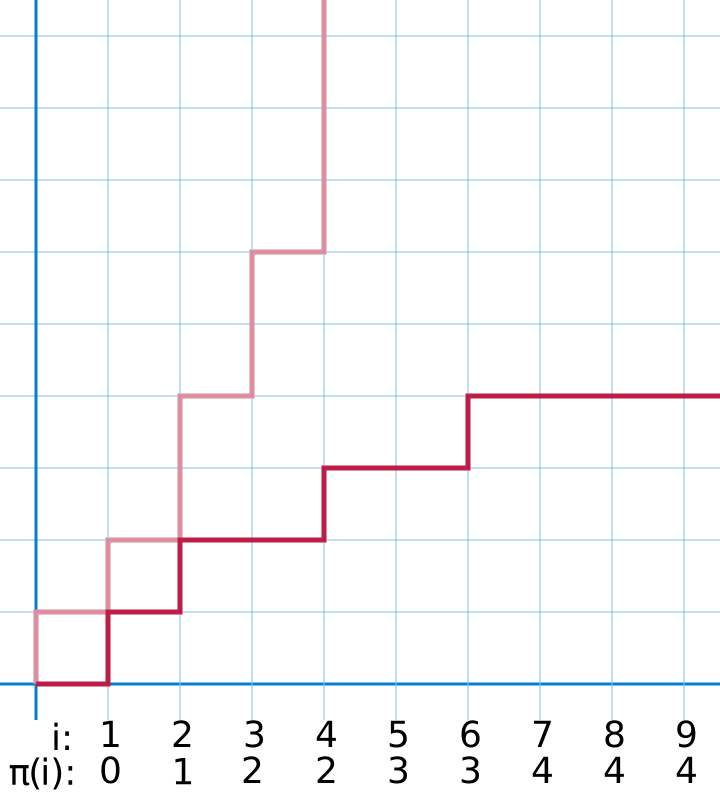
The Lambek–Moser theorem (\(\mathbb{M}\)) is a bijective equivalence between two different-looking mathematical objects: partitions of the positive integers into two disjoint subsets, and pairs of almost-inverse monotone functions from positive integers to non-negative integers.
Real monotone functions are inverse when their graphs are mirror reflections across the diagonal line \(y=x\). We can define something like a graph for an integer function, a staircase curve whose lowest point above any integer on the \(x\)-axis gives the function value; then two integer functions are almost-inverse when these curves are mirror reflections. The image below shows these two reflected staircase curves for the prime-counting function and its almost-inverse. This pair of functions corresponds to the partition of positive integers into prime and non-prime (composite or one).
By using this equivalence to go from functions to partitions and back, you can sometimes get amazing formulas for sequences of integers that you might not expect to have a formula at all. For instance, the \(n\)th number that is not a \(k\)th power (for integer \(k>1\)) has the formula:
\[n+\left\lfloor\sqrt[k]{n + \lfloor\sqrt[k]{n}\rfloor}\right\rfloor.\]Now a Good Article on Wikipedia.
-
Lisa Dusseault crafts a cellular automaton lace scarf (\(\mathbb{M}\)).
-
When science discourages correction: How publishers profit from mistakes (\(\mathbb{M}\)). Douglas Sheil and Erik Meijaard argue that the profit motive disincentivizes publishers from maintaining the integrity of the scientific record.
-
As part of the Integrated Explicit Analytic Number Theory network, Terry Tao finds a need to revive tables of logarithms, with machine-verified proofs of their accuracy (\(\mathbb{M}\)).
-
The Music of the Primes, Corinthia Beatrix Aberlé (\(\mathbb{M}\)). On connections between musical tuning systems and the Riemann zeta function.
-
CCC vs GCC (\(\mathbb{M}\)). An LLM-generated compiler passes all unit tests but somehow manages to generate code that runs complex SQLite queries 158,000 times slower than GCC.
-
I have been experimenting with ltx-talk as a replacement for beamer as a way to use LaTeX to make lecture slides (\(\mathbb{M}\)), in preparation for the April 24 doomsday in which all online content of all US universities is required to meet WCAG 2.1 A/AA accessibility standards (including properly tagged pdf). My test slide deck is based on beamer slides on union-find and its analysis from my graduate data structures course. It sort of works but is still obviously a work in progress.
Minor issues:
-
This requires lualatex 2025-11-01 or more recent. I can run this in Overleaf Labs but cannot find a recent-enough MacTeX.
-
The LaTeX preamble is different and the formatting changes it makes were largely undocumented.
-
I needed a hack to make natbib work. Actually two hacks but one was already there for beamer.
-
I had to change
\begin{frame}{Title}to\begin{frame}\frametitle{Title}everywhere. -
I had to change
\column{size}to\begin{column}{size} ... \end{column}everywhere. -
The tabular environment needs to be tagged for whether it is really a table (and which of its rows are headers) or just for formatting; see the LaTeX tagging project’s accessible formatting tips.
Major issues:
-
Compiling
$\approx 2\times 10^{19728}$(\(\approx 2\times 10^{19728}\)) caused lualatex to get into an apparent infinite loop and time out. Is it trying to calculate \(10^{19728}\)?? -
Some expressions with
$\dots$produce empty output. This would be a minor issue but having this empty output in the cells of a tabular environment caused lualatex to crash with the code “error: (nodes): fuzzy token cleanup in whatsit node with type whatsit and subtype 29”. Using$\ldots$or$\cdots$as appropriate worked. -
beamer has an option
\begin{frame}[allowframebreaks]that paginates overlong frames, necessary for bibtex bibliographies. It does not work in ltx-talk and I cannot find a replacement for this functionality. The test deck uses a tiny font for the bibliography but this is not very satisfactory and will not scale to larger bibliographies.
-
-
It’s good to see there are still people online crazy enough to think that emulating a GameBoy using arbitrary precision arithmetic implemented purely through compass and straightedge constructions is a good idea (\(\mathbb{M}\)).
-
The cleveref apocalypse is on us (\(\mathbb{M}\)). The cleveref LaTeX package is long-unmaintained and breaks on recent LaTeX versions, and an arXiv update to TeXlive means that we can no longer keep limping along using old-enough versions of TeX to avoid the problem. I haven’t yet tried it but my bookmarked solution is to switch to zref-clever.