Linkage with bulging mussels
When I upgraded to MathJax 4.0 last October, I failed to notice that its mathematics expression explorer prevented the \(\mathbb{M}\)-links to my Mastodon posts from working. Mouseover would show the url for the link (which is why I didn’t notice) but if you clicked on it you couldn’t get anywhere unless you knew to disable the speech and Braille options in the explorer first. I’ve updated the site to disable those options by default so that the links work. You can still re-enable speech and Braille, in the context menu on any mathematical expression, under Accessibility → Speech → Generate and Accessibility → Braille → Generate (the same options you previously needed to disable to get links to work).
Anyway, on to the links:
-
175 years of 3d viewing failure, starting with the 1851 Brewer Stereoscope, in honor of the big mid-January layoffs and cuts at Meta’s Reality Labs and Metaverse divisions.
-
The joys of data archaeology (\(\mathbb{M}\)): I happened to be looking up one of my old papers, “On triangulating three-dimensional polygons” (with Gill Barequet and Matt Dickerson, SoCG 1996 and CGTA 1998) when I realized that, although both published versions are open-access, the journal version has figures that have somehow been made completely illegible (all the grayscale is blacked out) and the conference version’s figures weren’t well reproduced either. My ftp links for alternative copies were long dead (nobody uses nor provides ftp any more). I do still have LaTeX source for the final version, but I couldn’t find all the figure files (probably buried as attachments in an associated unix-mail archive). And when I tried to compile it, even without having found all of the figures, the idiosyncratic LaTeX formatting from however long ago caused the text to keep switching mid-paragraph between two very different font sizes. Fortunately I was able to recover a preprint of the full journal version from one of those academic-web paper scrapers. The text is a little spindly because of the old formatting, but the figures are better. I put it back online and linked it from my publications page.
The main result of the paper, by the way, is that it is NP-complete to test whether a 3d polygon has a non-self-intersecting triangulation. Knotted polygons obviously don’t, but the polygons from the NP-completeness reduction are unknotted. Unknotted curves always form the boundary of a disk, but triangulating this disk might require many internal vertices, and the triangulations studied in this paper are allowed to use only the given vertices.
-
Purdue rescinds departmental graduate acceptance letters to over 100 students (\(\mathbb{M}\), via), mostly from China, under an unwritten university policy formulated in response to Trump administration pressure. A faculty quote: “when we’ve asked to get it in writing, [administrators] say they haven’t done it because then somebody could sue us.” As usual don’t read comments on the Y.
-
Nice profile of Robert Lang from 2024 by NASA (\(\mathbb{M}\)), explaining how his methods for designing the folding patterns for his artistic origami came out of methods he had been applying to pack components into integrated optical circuitry, and then later how he brought the same expertise back to NASA in work for them on packing components into space missions.
-
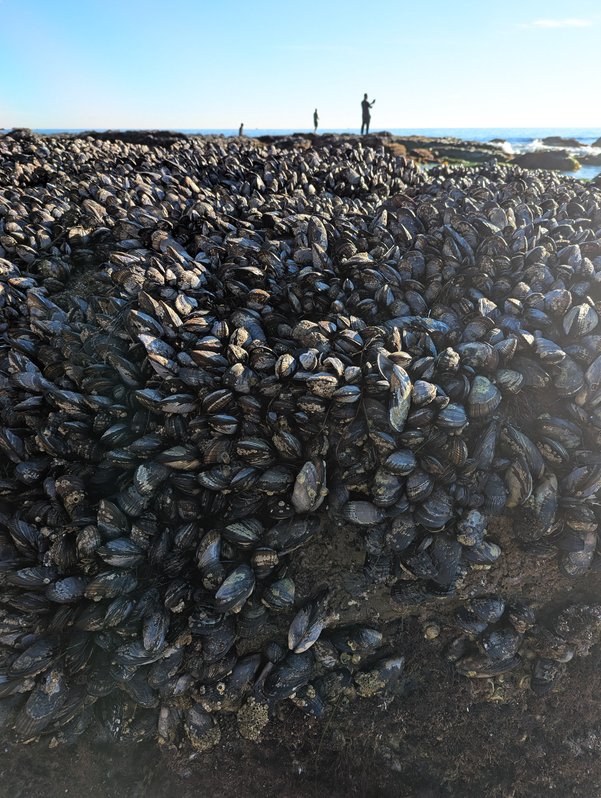
Warm winter weather and a holiday weekend made for a busy day at our local beach (\(\mathbb{M}\)). A few more photos.
-
A surprising fact about polyhedral self-duality (\(\mathbb{M}\)): There exist self-dual polyhedra for which the duality is not a self-inverse permutation of the set of vertices and faces. Robin Houston makes a 3d printable model.
-
An old Mastodon thread about triangular billiards and a new Wikipedia article about triangular billiards. The question is: if you made a billiards table in an arbitrary triangular shape, would it always be possible to find a starting position and direction for a billiards ball to travel so that (with ideal reflection and no friction) it would return to the same position and direction after finitely many bounces? It’s solved for triangles whose angles are acute or rational multiples of \(\pi\), but open in general.
-
Why do so many authors of enjoyable books end up being so problematic (\(\mathbb{M}\))? J. K. Rowling, transphobe. Neil Gaiman, sexual predator. And now I’m saddened to learn that R. A. Lafferty was a Holocaust denier. (Via a Wikipedia discussion where another editor, who does believe the accusations against Lafferty, was falsely accused of white nationalism for enforcing Wikipedia’s strict sourcing standards in this case. The source above does not meet those standards, but it is good enough for me personally.)
-
The 2026 Michael and Sheila Held Prize goes to Irit Dinur, Subhash Khot, Guy Kindler, Dor Minzer and Muli Safra for their work on the 2-to-2 games theorem (\(\mathbb{M}\)).
-
Temporary outage of full-text search in Google Books (\(\mathbb{M}\), via), only for books with preview rather than full view or snippet view. A few days later it started working again, as mysteriously as it stopped.
-
Calls for the IMU to publicly address the situation of the US hosting the International Congress of Mathematicians this year. Meanwhile the French Mathematical Society has announced that they will not be participating.
As I wrote in response: This is a big issue for academic conference planning in general, and not just for the ICM. My European friends are telling me that nobody they know there is currently willing to travel to the US and that for some of them there are institutional barriers in place (including issues of the security of institution-owned electronics) that prevent them from doing so. I have also talked to Canadians who have stopped attending conferences they would otherwise travel to in the US. Meanwhile there are also many people within the US who are unable to travel elsewhere for fear of not being allowed to return (which is not a strong argument for hosting international conferences in the US, but does raise problems for conference organizers elsewhere who might normally expect strong US attendance).
-
LICS breaks with ACM and IEEE, becoming an independently-run conference.
-
Domes made from rings of trapezoids topped by a pyramid of isosceles triangles have been seen in architecture since the construction of the Pantheon, and studied in geometry since della Francesca’s 15th-century De quinque corporibus regularibus. But what are they called? One possible answer: trapezium domes.
-
Generative AI and Wikipedia editing: What we learned in 2025 (\(\mathbb{M}\), via), from the Wiki Education project, which mainly interfaces Wikipedia with academic course projects involving editing Wikipedia. Their takeaway message: “Wikipedia editors should never copy and paste the output from generative AI chatbots like ChatGPT into Wikipedia articles.”
In more detail, they used Pangram to detect AI-written content, then checked it by hand (finding very few false positives!). They found only a low rate of hallucinated sources. However, more concerningly, in more than 2/3 of the flagged articles, they found sourced sentences whose sources did not contain the information in the sentence. More strongly, “For most of the articles Pangram flagged as written by GenAI, nearly every cited sentence in the article failed verification.” This also led to a high rate of wasted WikiEdu staff time cleaning up after the student-made AI additions (“far more time attempting to verify facts in AI-generated articles than if we’d simply done the research and writing ourselves”).
-
The staircase paradox gets linked from BoingBoing (\(\mathbb{M}\)).