Linkage
-
How Wikipedia’s editors (try to) keep the online encyclopedia human-written (\(\mathbb{M}\), via). Eliza Strickland of IEEE Spectrum interviews Ellia Lebleu, a founding member of Wikipedia’s AI Cleanup project.
-
Analyzing the simplex method by-the-book (\(\mathbb{M}\)). 21-minute STOC’26 video by Sophie Huiberts and her collaborators, explaining why the rounding and random perturbations commonly used in implementations of the simplex method for linear programming make it behave differently from worst-case exponential examples, converging in polynomial time to good solutions for well-scaled input instances. See also their STOC paper.
-
I’m pretty sure I’ve complained about this before (\(\mathbb{M}\)), but when my campus’s photographer (officially a managing producer-director in the Office of Strategic Communications & Public Affairs) comes around to take free faculty/staff portraits, as he does every couple of years, he tells us “you can do what you want with them”, but it’s not true. It’s a work for hire, so the copyright on the photos is owned by the Regents of the University of California, who will not release them under an open-access Creative Commons license, so they cannot be used for instance on Wikipedia. Nobody has figured out the cheat codes for this piece of bureaucracy, so we end up getting a nice set of photos that are not actually as usable as they should be.
Anyway, I have a new headshot. I kind of like how it came out, but the best my family will say about it is “it looks like you”. To spare you all from having to look at my no-longer-middle-aged face, I won’t inline it here, but you can find a copy on my home page.
-
A dot planimeter (\(\mathbb{M}\)) is just a fancy name for a transparent sheet with a square grid of dots printed onto it. You can estimate the areas of shapes by overlaying it on the shape and counting the dots. Now another Good Article on Wikipedia.
-
University libraries are being swarmed by AI bots, putting public access at risk (\(\mathbb{M}\)), says the CBC.
-
Richard Schwartz discovers how to fold the simplest origami torus (\(\mathbb{M}\)). Manon Bischoff in Scientific American; see also Schwartz’s PNAS paper.
-
I upgraded my phone today (\(\mathbb{M}\)), at an office of my service provider, a couple miles from my house. As I was finishing up the purchase, the sales clerk asked me a question so unexpected that I had to stop for a few seconds to figure out what she meant: Do you know how to get home?
The point was that my phone wouldn’t be able to map the way for me until I had set it up. I almost never use in-car maps; if it’s not a place I’ve been before, I’d much prefer to study a map beforehand and memorize the route, and if (as in this case) I’ve been there before I can remember it. But so many people today have lost that skill and in many cases can’t even read a map. I find it all a bit sad.
So yes, I did know how to get home.
-
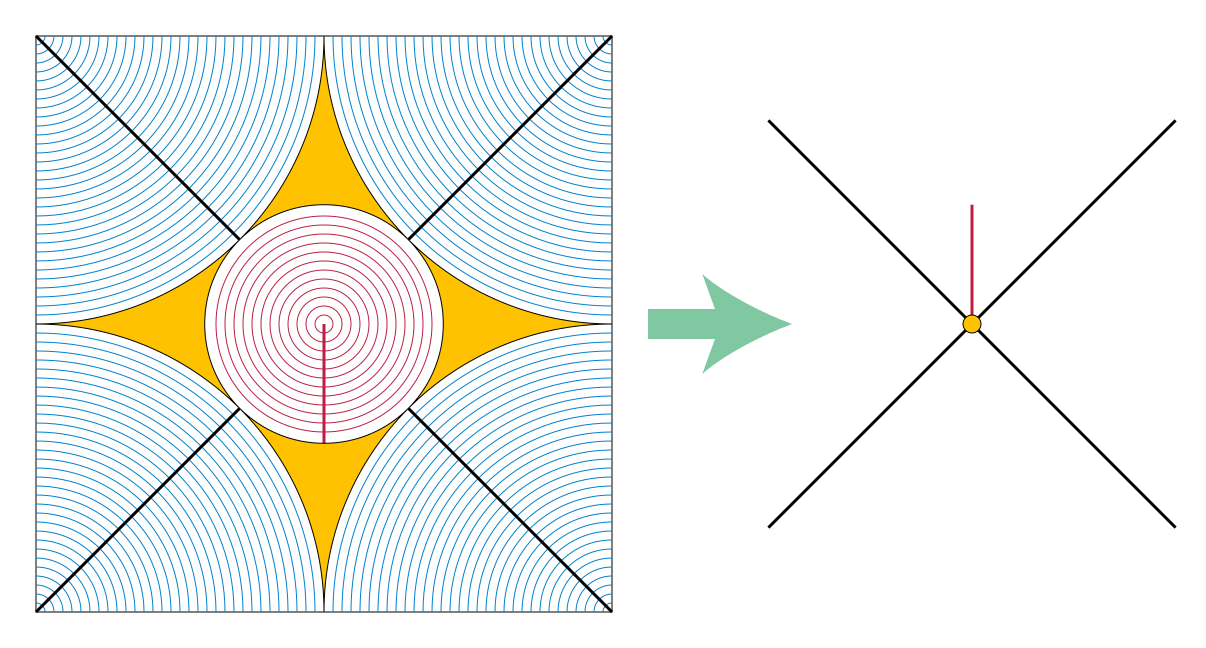
I made this illustration (\(\mathbb{M}\)) for the Wikipedia article on the problem of folding a square to make a shape of greater perimeter than you started with. It depicts a map from a square to a tree, that does not increase any distance (a “short map”), but that does increase the perimeter of its image. Each red circle or blue circular arc in the square is mapped to its thick centerline at the point where it crosses the centerline; these centerlines become the branches of the tree. The yellow regions of the square are all mapped to a single point where the branches meet. The perimeter of the black part of the tree is the same as the square; the doubled length of the red branch is added on top of that. Svetlana Krat’s 2005 Ph.D. thesis includes both this map (and its generalization to rectangles) and a method of approximating short maps by foldings, to give a novel solution to the napkin folding problem.
-
Why are rivers so mathematical? (\(\mathbb{M}\)). Natalie Wolchover in Quanta on the scaling laws of river networks.
-
Knotting spheres in the 4th dimension (\(\mathbb{M}\)). 4-minute video by Henry Segerman that combines 3d printing with the 2d drawing conventions of 1d knots in 3d, to make 3d knot diagrams of 2d knots in 4d.
-
On the statistics of close multiway elections (\(\mathbb{M}\)), using the recent Mississippi US Senate race as an example.
-
All 1665 submissions to STOC 2027, online (\(\mathbb{M}\)) following STOC’s new procedure of publication first, verdict afterwards.
-
Catherine Holloway explains her uncle David Huffman’s work on the mathematics of origami (\(\mathbb{M}\)). 21-minute YouTube talk.
-
Inscribed zonotopes, simplicial arrangements, and reflection groups (\(\mathbb{M}\)), Sebastian Manecke and Raman Sanyal. These are an unusual class of special zonotopes all of whose vertices belong to a sphere, in 17 combinatorial types, several of which are animated in the Mastodon thread. The planar equivalent, zonotopal tilings in which all faces are inscribed in circles, turn out to be dual to simplicial arrangements.