Linkage
-
arXiv imposes a new limit of two submissions per submitter per month (\(\mathbb{M}\)).
-
Book of Shapes: A collection of minimal, generative and customizable SVG-patterns (\(\mathbb{M}\), via).
-
Sham scientific societies are misleading star researchers, according to Nature (\(\mathbb{M}\), via).
-
The \(13\times 13\) zebra graph is untraceable (\(\mathbb{M}\)). A zebra is a fairy chess piece that jumps like a longer knight, two steps in one direction and three in another. Almost a proof without words that the graph of its moves on a \(13\times 13\) chessboard has no Hamiltonian path.
-
The Harvard/Smithsonian Astrophysics Data System, a large bibliographic database for astronomy, astrophysics, and related fields, has been transitioning for the last year or so to become SciX with expanded areas of coverage “across space, Earth, and planetary sciences”, and is scheduled to complete the move in mid-November (\(\mathbb{M}\)). It’s difficult to find much about the move from adsabs to SciX that isn’t both heavy on promotion and light on content, but their press release is better than some, and there’s documentation on how to use SciX.
If you’ve ever wondered what those “bibcode” tags associated with some scientific references are, they’re pointers into this database. I imagine non-mathematicians have similar questions about what those “MR” and “Zbl” tags used for mathematical references are; the answer is the same, pointers to the MathSciNet and zbMATH databases respectively. And now I’m wondering why DBLP doesn’t have its own tags for computer science references.
-
Denny Vrandečić stumbled into a rabbit hole of unsourced Wikipedia claims about the production of a Spider Man movie, and AI hallucinations and circular reasoning when he tried to search for the missing sources and the edits that added the claims. The claims were eventually reinstated with proper sourcing, through the community of human editors of Wikipedia; Vrandečić concludes that, in contrast, “the AI in this case was actively harmful”.
-
If your \(\LaTeX\) input encodes an en-dash as a double-hyphen
--, TeX will allow a line break after it. If it encodes it as a unicode en-dash character–, it will not allow a line break, both in pdflatex with\usepackage[utf8]{inputenc}and lualatex without (\(\mathbb{M}\)). Additionally, with the unicode en-dashes, pdflatex and lualatex will differ in how they break the words between the dashes: pdflatex will not break and hyphenate “Koebe–Andreev–Thurston” at all, but lualatex will break it as “Koebe–An- [line break] dreev–Thurston”. With double-hyphens, both are happy to produce the much better output “Koebe– [line break] Andreev–Thurston”. So let this be a lesson not to try to be fancy in how you type your dashes in \(\LaTeX\). Just use double hyphens (or triple hyphens for em-dashes) and let \(\LaTeX\) do the conversion to dashes. -
On searching Wikipedia for article titles containing colons, like “ST:TNG”. It will think you are looking for an article titled “TNG” in the Sotho-language Wikipedia, regardless of how you try to escape the colon. But it turns out that, for Wikipedia, colons that are actually given in titles rather than used to demark other namespaces are equivalent to spaces. So the string you want to search for is “ST TNG”.
-
Numberphile video on Connor Hill’s classification of noble polyhedra (\(\mathbb{M}\)). A noble polyhedron has all faces and all vertices symmetric to each other, but not necessarily all edges. There are two infinite families and a lot of sporadic examples, especially if you allow self-intersections. Hill won the 2026 International Science and Engineering Fair, a high school student competition, for his determination of the complete list.
-
Show that two “ice cream cones” in a regular pentagon have the same angle (\(\mathbb{M}\)). A challenge problem on the mathematics StackExchange with a pretty diagram illustrating it.
-
Spanning surfaces of the same knot that cannot be deformed into each other, even in 4d (\(\mathbb{M}\)). Research from 2022 by Kyle Hayden, Seungwon Kim, Maggie Miller, JungHwan Park, and Isaac Sundberg, reported on at the time by Quanta, and helpful in understanding Maggie Miller’s new Joy of Why podcast episode “What Does the Fourth Dimension Actually Look Like?”.
-
What even is mathematical output? (\(\mathbb{M}\)). Among thoughts on AI in mathematics, David Roberts collects a farm of expert quotes on how horribly badly written and unintelligible the recent OpenAI preprint dump has been. Their Lean proofs aren’t any better: they contain large chunks of junk code that literally do nothing.
-
The septopert, a seven-sided polyhedron that cannot fit through a hole in itself.
-
Celebrating Loday’s associahedron (\(\mathbb{M}\)), 2023 survey by Pilaud, Santos, and Ziegler. See also two more recent articles on coloring the vertices of the associahedron: “A double-logarithmic upper bound on the chromatic number of the associahedron” (Oum and Wood), and “The chromatic number of the associahedron: simple and logarithmic” (Berendsohn, Cardinal, Iacono, and Kozma).
-
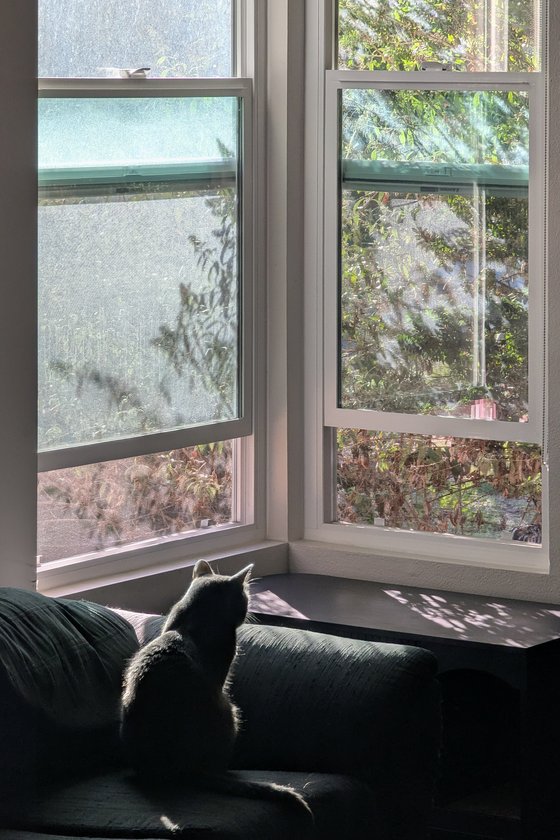
One of my cats, Smoke, looks through a window in the morning light (\(\mathbb{M}\)).