Linkage
-
Another mathematics journal leaving its commercial publisher (\(\mathbb{M}\)), but with a twist: usually this is accomplished by a mass resignation of the editorial board. But in this case, Communications on Pure and Applied Mathematics is owned by the Courant Institute and was published by Wiley, so taking it in-house is just a matter of not renewing the contract. The causes of friction were increased publisher interference with editorial decisions (the usual), but also editor dissatisfaction with the publisher’s editorial management software.
-
An American privacy emergency (\(\mathbb{M}\)): Cynthia Dwork on how new US government regulations forbidding the Census Bureau from masking its released data under differential privacy will give us less usable data, reduced protection against privacy-violating disclosures, or both. Cynthia also provides information about what you can do to help work against this.
-
A reduced planar body with area greater than \(\pi\Delta^2/4\) (\(\mathbb{M}\)), new preprint by Scott Duke Kominers. Here, “reduced” is a concept for two-dimensional convex bodies that is closely related to having constant width. The directional width is the distance between parallel support lines, constant width means that all directional widths are the same, thickness means the minimum directional width, and reduced means that any convex body that is a proper subset has smaller thickness. So bodies of constant width are reduced but not necessarily vice versa. For instance both Reuleaux triangles and equilateral triangles are reduced; the first has constant width, the second does not. A structure theorem described in the paper states that reduced bodies have parts of their boundary with constant width and parts that are flat.
Anyway, it had been conjectured that the formula in the title was the maximum area for a reduced body of thickness , with bodies attaining that area including the circular disk and quarter-disk. As evidence for the conjecture, it is true both for shapes of constant width and for polygons. But the paper describes a shape resembling a sharper wedge of a disk than a quarter, with a rounded apex, that slightly betters this area.
-
Ed Pegg sent me the image below (\(\mathbb{M}\)) illustrating some of the minimal geometric independent dominating sets (small sets of grid points with no three in line to which no additional grid point can be added) from my EuroCG’21/CGTA’23 paper with Aichholzer and Hainzl, “Geometric dominating sets – A minimum version of the no-three-in-line problem”. See also Ed’s Wolfram community post about these sets.
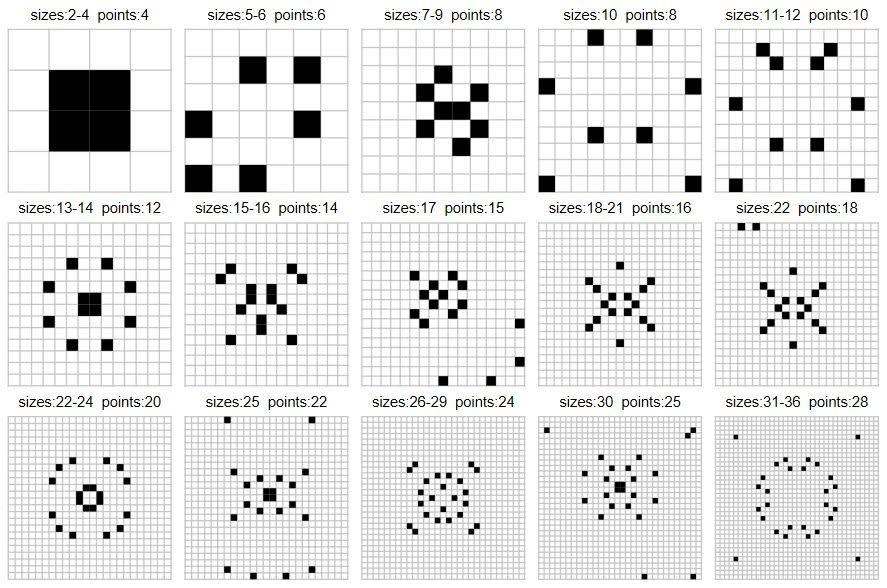
-
Geometric models by A. Harry Wheeler in the Smithsonian Institution (\(\mathbb{M}\)). Another set of Wheeler models that for some reason doesn’t appear in the main list: Dissected polyhedra transformable into other polyhedra. For more on Wheeler, see Wheeler’s Wikipedia biography
-
Shachaf observes that, in the computable reals, you can find the values of a sorted list but you cannot determine its permutation, in response to another post claiming that sorting code that doesn’t explicitly discuss permutations is “awful”. But this raises questions about constructive type theory: how can you specify that this is a sorting algorithm without having a decidable notion of equality?
-
Does anyone know a reference for the following easy theorem about estimating area by counting lattice points (\(\mathbb{M}\)), extending Nosarzewska’s inequality from convex to simply-connected regions?
Let \(J\) be a region of area \(a\) bounded by a Jordan curve of length \(p\). Then:
\[|a - \#(\mathbb{Z}^2\cap J)| = O(p+1).\]Proof: sweep a unit square around the boundary of \(J\); by Cavalieri’s principle the area of the swept region \(B\) is \(\le 1+p\sqrt 2\). Consider the Voronoi cells of the integer lattice; outside of \(B\) they are completely inside or completely outside \(J\). Therefore,
\[\begin{align}a-1-p\sqrt 2&\le \operatorname{area}(J\setminus B)\\&\le \#(\mathbb{Z}^2\cap J)\\&\le \operatorname{area}(J\cup B)\\&\le a+1+p\sqrt 2.\end{align}\] -
Emacs org-mode adds support for using ltx-talk in \(\rm{\LaTeX}\) to produce accessible slides in tagged pdf format (\(\mathbb{M}\)).
-
Two-sided ruler constructions (\(\mathbb{M}\)). A series of blog posts by David K. Butler on how to use an unmarked ruler with two parallel edges to do almost everything that you could do with a ruler and compass.
-
Reformatted schedule for the International Congress of Mathematicians (\(\mathbb{M}\)) with MathJax abstracts that don’t require clicky popups to read, by M.-J. Dominus.
-
OpenAI claims a very short proof of the cycle double cover conjecture (\(\mathbb{M}\)).
-
Chris Staecker live-tweets the figures for an in-progress digital topology book, deliberately omitting any explanations of the figures.
-
Terry Tao on Gilbreath’s conjecture (\(\mathbb{M}\)). The first difference sequence of the prime numbers starts 1, 0, 2, 2, 2, 2, 2, 2, 4, … . The second, third, and fourth difference sequences all start with 1, 2, 0, 0. The first numbers in each sequence must be odd and the rest even, but which odd number? Gilbreath and before him Proth conjectured that every difference sequence begins with 1. Merely having the same small gaps and parity properties as the primes does not suffice: see my old blog post “Anti-Gilbreath sequences” for sequences with these properties whose difference sequences have infinitely many non-1 starting values.
The primes are thought to behave similarly to random sequences, so researchers have attacked the problem by studying prime-like random sequences. Past work by Chase shows that sequences whose gaps between consecutive elements are random with very slow growth (slower than the primes) almost surely have all but finitely many difference sequences beginning with 1. Now a new preprint by Chase, Tao, and Zach Hunter, using a structural characterization of anti-Gilbreath sequences related to my post, extends Chase’s work to a model of random sequences with geometrically distributed random gaps of sizes matching the prime numbers. It still doesn’t address the actual prime numbers but I think by matching their distribution better it provides strong evidence for the conjecture.
-
How LLM nonsense is affecting Wikipedia: increased drama and increased volunteer workload triggered by “crap articles generated by LLMs, or people using LLMs to write extremely wordy, unhelpful replies to concerns about their behaviour”.