Linkage
-
Congratulations to Ken Clarkson and the rest of the newly-named SIAM Fellows (\(\mathbb{M}\))!
-
Richard Elwes on Numberphile talking about big numbers (\(\mathbb{M}\)). The twist: these ones are from many centuries ago, from Jain mathematicians. They got at least as far as tetration.
-
How wireless origami cushioning could improve logistics (\(\mathbb{M}\)), by providing shipping damage alerts in real time.
-
The long-predicted cleveref apocalypse is upon me (\(\mathbb{M}\)). For the most part it works to just replace
\usepackage[capitalize,nameinlink]{cleveref}by
\usepackage{zref-clever}
\zcsetup{cap}
\let\cref\zcref
I have been using an “observation” theorem type, and for this I need to tell zref-clever what to call them:
\zcRefTypeSetup{observation}{Name-sg=Observation,Name-pl=Observations}If you want to have different theorem types share the same numbers, things get more complicated. I haven’t needed that yet, but there’s guidance in Section 10.2 of the zref-clever user manual.
-
After a long-ish quiet period, quite a few new solutions to the no-three-in-line problem have been discovered this year (\(\mathbb{M}\)).
-
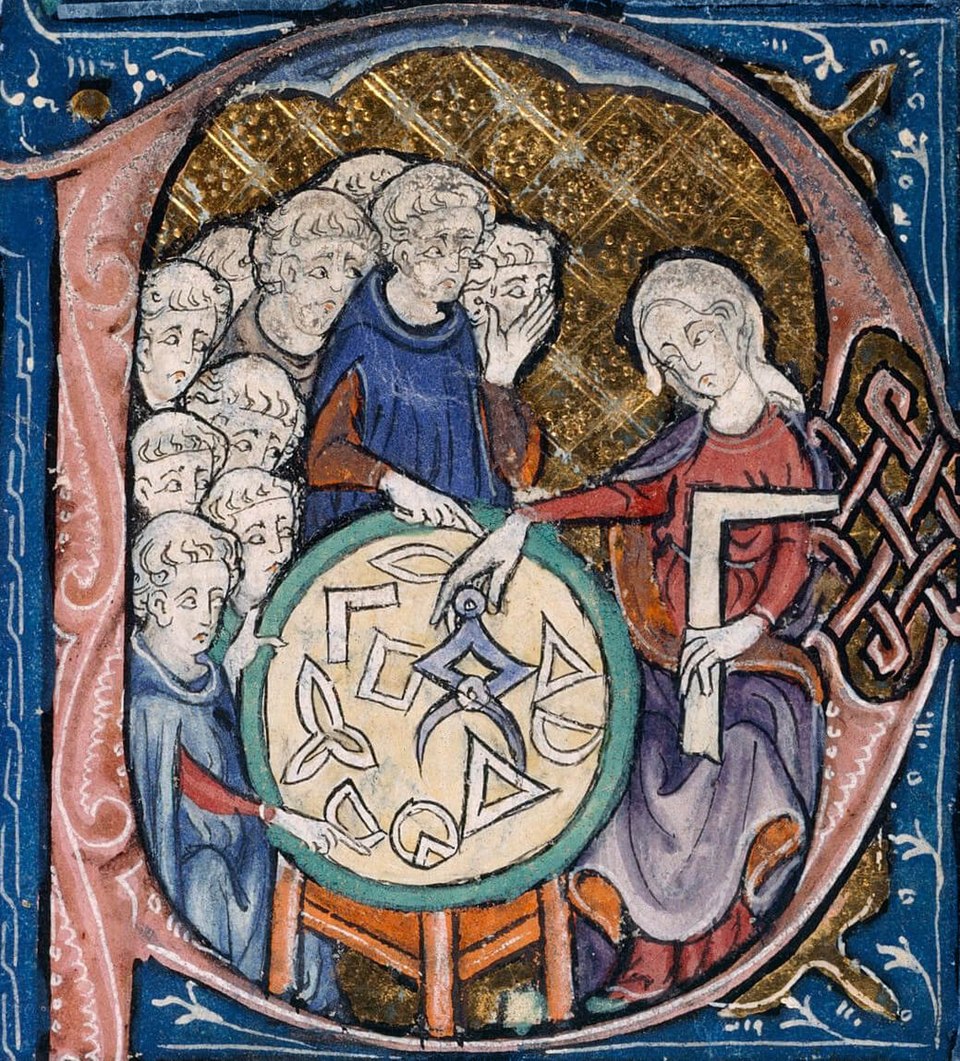
A medieval woman teaches geometry to a group of students (\(\mathbb{M}\)). From an early 14th-century manuscript of Euclid’s Elements. Sadly, most online sources make the sexist inference that a woman couldn’t possibly have been a geometry teacher then, and therefore that she must instead be a “personification of geometry”.
-
Deterministic primality testing for limited bit width (\(\mathbb{M}\)). Precomputing a small set of good bases gives a fast derandomization of the Miller–Rabin primality test.
-
The Music of the Spheres (\(\mathbb{M}\)), sequence from the Saturday Morning Breakfast Cereal comic strip, coauthored by Terry Tao, on what mathematicians do and the unreasonable effectiveness of mathematics, as illustrated through the sphere packing problem.
-
Alison Martin folds a single sheet of paper into an umbilic torus (see also).
-
Cathedral building geometry basics: how to find the center of a circle with compass and straightedge (\(\mathbb{M}\)). It might not come as a surprise that people who repair stonework on old cathedrals with handheld chisels and hand-poured molten lead (the rest of the content on this YouTube channel) might also prefer to make their architectural drawings and templates by hand instead of with a CAD system.
-
Tariq asks: What do people recommend for publication quality plots of mathematical functions?
-
Many sequences in OEIS come from various real-world applications. Jeremy Kun looks for the opposite: open-source code that has applied OEIS sequences in unusual ways (\(\mathbb{M}\)). These include music synthesis, pen tool size settings, and geocaching.
-
Through a new Wikipedia article I learn that Uruguay has a museum devoted to origami (\(\mathbb{M}\)), claimed to be the only one in the Americas.
-
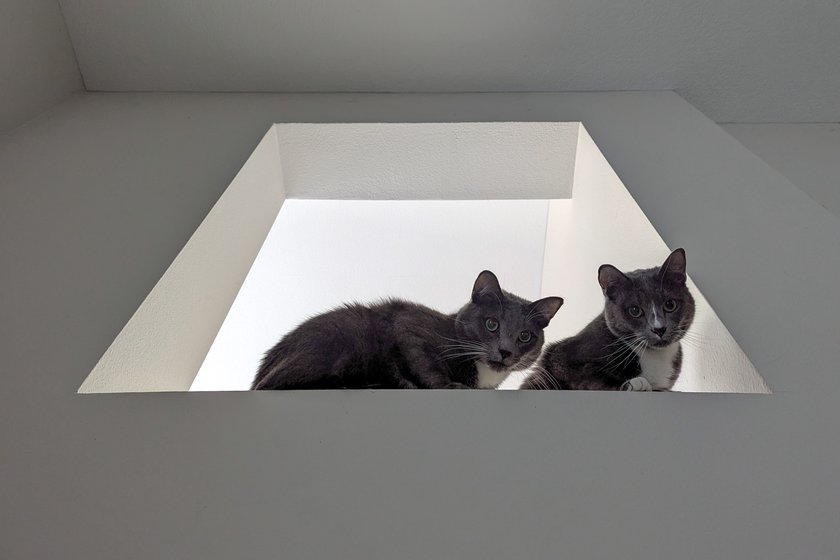
Cats on a lintel (\(\mathbb{M}\)):