Linkage
-
The code that revolutionized orbital simulation (\(\mathbb{M}\)), video by braintruffle on how updating velocity and position sequentially rather than in parallel causes orbital simulations to preserve symplectic invariants and thereby become much more stable.
-
The mathematics of optimal gift-wrapping (\(\mathbb{M}\), via). First, imagine a cubical gift…
-
How to cage an egg, a well-known paper by Oded Schramm on polyhedra with edges tangent to a given smooth convex body, leaves Robin Houston asking: should you cage your eggs?
-
ACM starts showing unwanted and unlicensed AI summaries on its digital library publications (\(\mathbb{M}\), see also, via).
-
Computing in Geometry and Topology, a diamond open access journal in computational geometry and computational topology that I co-founded a few years ago, is now listed in DBLP (\(\mathbb{M}\)).
-
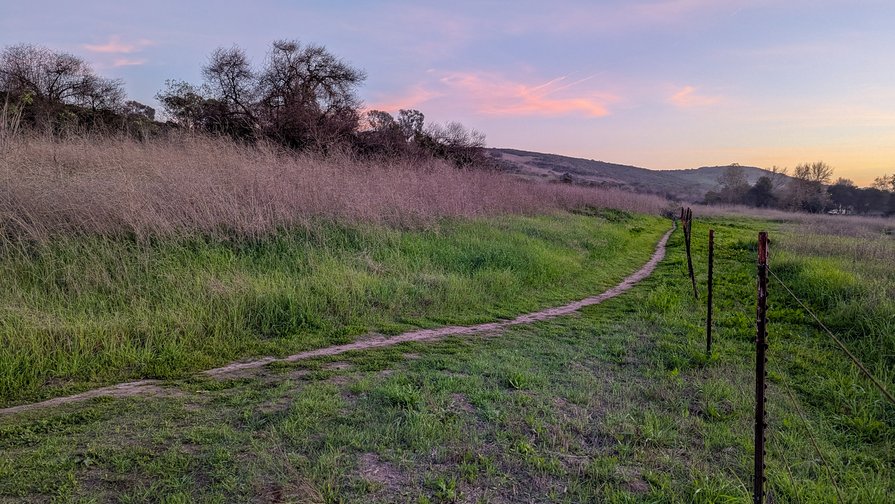
This season’s green starts to come back to the UCI Ecological Preserve, after the usual dry brown summer and fall (\(\mathbb{M}\)).
-
As a follow-up to my recent post constructing regular link-irregular graphs, Jannis Harder proves that almost all dense random regular graphs are link-irregular (\(\mathbb{M}\)).
-
Lean formalization of Chvátal’s conjecture on stars vs intersecting subfamilies in independence systems (\(\mathbb{M}\)).
-
A genus-zero surface with bounded curvature enclosing less volume than the unit sphere (\(\mathbb{M}\)), called the “amogus surface” in the Mastodon post but sadly not in Matthew Bolan’s arXiv preprint.
-
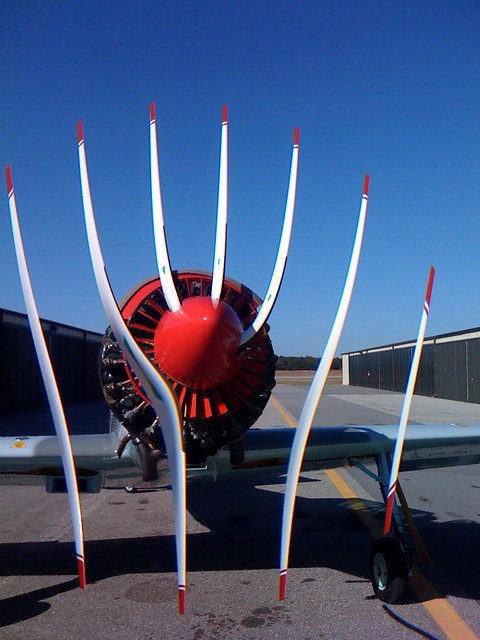
Quadratrix of Hippias, now a Good Article on Wikipedia (\(\mathbb{M}\)). This is a curve swept out by the crossing point of two moving lines, one rotating and one translating. The ancient Greeks discovered that if you have a copy of this curve already, you can use it to trisect angles and construct a square with the area of a given circle, two classical geometry problems that are impossible with compass and straightedge alone. As I wrote on an earlier blog post, you can also see curves like this when you take a photo of a spinning airplane propellor using a camera with a rolling shutter:
-
Ametameric (\(\mathbb{M}\)), a 16-color accessible color palette intended for syntax-colored text, with nice visualization of all pairwise color contrasts under different color vision deficiencies.
-
CNRS dumps Clarivate’s bibliographic databases including Web of Science and Journal Citation Reports (\(\mathbb{M}\)), explaining “We have worked for free to lock ourselves collectively into a paid system, but no more!”
-
Young redwoods near Big River Beach (\(\mathbb{M}\)).

-
Doubly dual shuffles (\(\mathbb{M}\)), four different ways of implementing the Fischer–Yates random permutation algorithm. The discussion goes into why you might choose one over another depending on whether you want to leave items in place after they’re permuted once, or whether the stream of items to be permuted has unknown length.
-
Disproof of the odd Hadwiger conjecture (\(\mathbb{M}\)), new preprint by Marcus Kühn, Lisa Sauermann, Raphael Steiner, and Yuval Wigderson. This is the one on the relation between clique minors (with paths of odd length between designated seed vertices) and coloring. They construct graphs for which the chromatic number is higher than the odd clique minor size by a factor of roughly \(\tfrac32\).
